|
To view this email as a web page, click here. |
|
|
|
Welcome
The protein FASTA file for NCBI nr has been discontinued, but you can still compile it locally.
This month's highlighted publication investigates immunoregulation during pregnancy.
Configuring Mascot Server as a system service on Linux is now simple using a new systemd unit file.
|
|
|
|
|
|
 |
|
Mascot: The trusted reference standard for protein identification by mass spectrometry for 25 years
|
Get a quote
|
|
|
|
|
|
Replacements for NCBI nr
|
|
|
NCBI nr is the comprehensive database of non-identical protein sequences compiled by the National Center for Biotechnology Information.
The database configuration has long been shipped with Mascot Server as the NCBIprot predefined definition.
However, it seems the FASTA file has quietly been retired; the last version appears to be the February 2024 file.
BLAST itself has not been discontinued, so it is still possible to compile the database locally.
You will need to install the blast+ package from NCBI and Perl.
The blast+ command update_blastdb.pl downloads BLAST in compressed chunks, totalling about 354GB at the time of writing.
The chunks need to be decompressed (expanding to about 600GB).
Then, blastdbcmd can be used for extracting the FASTA formatted database as nr.fasta, which requires another 450GB of disk space.
The detailed steps for compiling and configuring NCBI nr are in our blog.
We've always advised that NCBI nr is a database of last resort due to its sheer size.
One good alternative is the UniProt TrEBML database.
The upcoming 2026_02 release of UniProt will see a reorganisation of TrEMBL, which increases the number of reference proteomes and reduces the number of unannotated or poorly annotated sequences.
This will provide comprehensive coverage across the Tree of Life, which was the most common use case for NCBI nr.
|

|
|
|
|
|
|
|
|
Featured publication using Mascot
Here we highlight a recent interesting and important publication that employs Mascot for protein identification, quantitation, or characterization. If you would like one of your papers highlighted here, please send us a PDF or a URL.
|
|
|
Amniotic fluid glycoproteins as potential ligands for macrophage galactose-type C-type lectin and their possible implications for immunoregulation during pregnancy
Justyna Szczykutowicz, Mariusz Zimmer, Magdalena Orczyk-Pawiłowicz
Scientific Reports 15:32966, 2025
During pregnancy, maternal and fetal immune systems must balance protection against pathogens while avoiding fetal rejection.
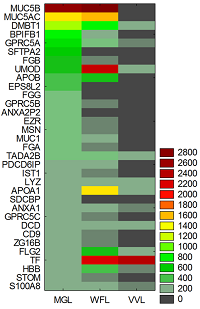
The authors investigate macrophage galactose-type C-type lectin (MGL) interactions with amniotic fluid glycoproteins, which is thought to protect against excessive inflammation and autoimmune diseases.
They reveal several MGL ligands, including mucins, mucin-like proteins and uromodulin, supporting the hypothesis of MGL-mediated immune balance during pregnancy.
To investigate, the authors performed MGL pull-down assays using pooled term amniotic fluid samples, comparing Ca2+-activated MGL to negative controls (GalNAc-saturated MGL).
Following 1D gel separation, routine alkylation and trypsin digestion, samples were analyzed by LC-MS/MS (Evosep One/Orbitrap Exploris 480).
Data were processed with Mascot Distiller and searched against the human proteome, using HexNAc (ST) as a variable modification to identify O-linked glycan ligands.
Bioinformatics analysis included STRING for protein-protein interactions, Gene Ontology, and Reactome pathway analysis.
|
|
|
|
|
|
|
|
|
Mascot Server as system service on Linux
|
|
|
Mascot Server runs a background service called Mascot Monitor (ms-monitor.exe).
The Monitor service is responsible for managing sequence databases, and it must be running in order for the search engine to execute.
On Windows, the Mascot Server installer automatically configures a suitable system service.
On Linux, we have now simplified the procedure with a new systemd unit file.
Follow the instructions on the new help page, download the systemd unit file and copy it in the right place.
The only configuration that may be required is the installation path of Mascot Server.
Once the unit file is active, the service can be controlled using the standard systemctl utility.
|
 |
|
|
|
|
|
|
|
About Matrix Science
Matrix Science is a provider of bioinformatics tools to proteomics researchers and scientists, enabling the rapid, confident identification and quantitation of proteins. Mascot continues to be cited by over 2000 publications every year. Our software products fully support data from mass spectrometry instruments made by Agilent, Bruker, Sciex, Shimadzu, Thermo Scientific, and Waters.
Get a quote
|

|
|
You can also contact us or one of our marketing partners for more information on how you can power your proteomics with Mascot.
|





|
|
|
|
|