|
To view this email as a web page, click here. |
|
|
|
Welcome
We presented three posters on Mascot DIA at ASMS 2026.
This month's highlighted publication demonstrates an optimised process for extracellular vesicle production from mesenchymal stem cells.
Come meet us at BSPR 2026 and IMSC 2026.
|
|
|
|
|
|
 |
|
Mascot: The trusted reference standard for protein identification by mass spectrometry for 25 years
|
Get a quote
|
|
|
|
|
|
Mascot DIA posters
|
|
|
It was a pleasure to meet many of you at ASMS 2026 in San Diego, CA this June.
We presented three posters featuring Mascot DIA, which cover different aspects of its peptide identification and quantitation strategy.
WP 449: Mascot DIA introduces probabilistic scoring to spectrum-centric analysis of DIA data.
Most software packages for data-independent acquisition (DIA) are peptide-centric.
They depend on a precomputed spectral library with accurate fragment intensity predictions, limiting the choice of instrument, proteome, enzyme and variable modifications.
We have developed a new probabilistic scoring model for identifying peptides from convoluted DIA MS/MS spectra.
The model is independent of machine learning and overcomes peptide-centric limitations.
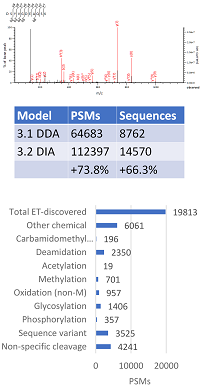
WP 464: Mascot DIA enables direct comparison of DDA and DIA identification and quantitation results.
We reanalysed data from PRIDE project PXD028735 acquired in DDA and DIA modes on the same instrument.
Mascot does not need to deconvolute DIA spectra.
The same sequence matching and precursor quantitation algorithms are used for DDA and DIA spectra, allowing results to be directly compared and the same downstream processing to be used between the two techniques.
WP 622: Overcoming Peptide-Centric DIA Limitations: Discovering Unsuspected Modifications in Narrow-Window DIA Using Mascot Error Tolerant Search.
All the functionality of DDA is available in Mascot DIA, including the Mascot Error Tolerant search.
This is a two-pass search: a standard first-pass search identifies proteins, then a comprehensive second pass iterates through the entire Unimod modification list, plus sequence variants.
We reanalysed data from PRIDE project PXD037506 acquired in DIA mode and discovered evidence of unsuspected non-specific cleavage, sequence variants, glycosylation and phosphorylation.
The poster PDFs are available for download on our website.
|
|
|
|
|
|
|
|
|
Featured publication using Mascot
Here we highlight a recent interesting and important publication that employs Mascot for protein identification, quantitation, or characterization. If you would like one of your papers highlighted here, please send us a PDF or a URL.
|
|
|
Tuning Hydrogel Mechanics and Microstructure to Maximize Extracellular Vesicle Production from Mesenchymal Stem Cells
Riddhesh B. Doshi, Bethany Yee, Nicolas Warburton, Juanfang Ruan, Richard Tilley, Kuldip Sidhu, Kristopher A. Kilian
Cellular and Molecular Bioengineering, 2026, doi:10.1007/s12195-026-00917-x
Extracellular vesicles (EV) produced by mesenchymal stem cells (MSCs) are a promising option for regenerative medicine.
The authors demonstrate an optimised process for EV production by utilising hydrogel microcarriers, which could be tuned to maximise EV production up to 18-fold compared to monolayer cultures.
The mechanical properties and microstructure of hydrogels were precisely tuned and evaluated using shear technology.
EVs were analysed using rheological analysis, imaging techniques, proteomics and functional assays.
Two types of MSCs were cultivated, adipose derived stem cells (ADSCs) and induced pluripotent stem cell derived MSCs (iMSCs), which were cultured on tissue culture plastic (TCP) and gelatin methacryloyl (GelMA) hydrogels.
For the proteomic analysis, EVs were isolated and subjected to secretome profiling using LC-MS/MS.
The raw data were processed with Mascot Distiller and proteins identified via database searching with Mascot Server.
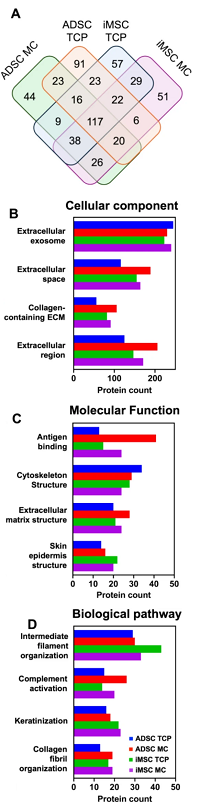
The authors identified a total of 117 proteins common across all conditions.
Eighteen proteins were unique to ADSC-EVs from TCP and 22 from microcarriers, while 26 and 25 unique proteins were found in iMSC-EVs from the same conditions.
A biological pathway analysis indicates that EVs from GelMA microcarriers (MC) were predominantly involved in complement activation and collagen fibril organization, which are critical for wound healing.
|
|
|
|
|
|
|
|
|
BSPR 2026 and IMSC 2026
|
|
|
In July, we're travelling to Cambridge, UK for BSPR 2026, taking place on 13-15th July.
Come chat with us about the latest developments with Mascot.
In August, meet us in Lyon, France at IMSC 2026.
We'll be at booth #40 for the duration of the conference, 22nd-28th August.
Join us there and see a demo of the latest version of Mascot.
|

|
|
|
|
|
|
|
|
About Matrix Science
Matrix Science is a provider of bioinformatics tools to proteomics researchers and scientists, enabling the rapid, confident identification and quantitation of proteins. Mascot continues to be cited by over 2000 publications every year. Our software products fully support data from mass spectrometry instruments made by Agilent, Bruker, SCIEX, Shimadzu, Thermo Scientific, and Waters.
Get a quote
|

|
|
You can also contact us or one of our marketing partners for more information on how you can power your proteomics with Mascot.
|




|
|
|
|
|