|
To view this email as a web page, click here. |
|
|
|
Welcome
Installing a Mascot Parser skill in your AI coding assistant unlocks automation and custom reporting.
This month's highlighted publication compares alternative methods for N-terminal protein derivatization.
When you need to move Mascot to new hardware, simply contact us for a replacement product key.
|
|
|
|
|
|
 |
|
Mascot: The trusted reference standard for protein identification by mass spectrometry for 25 years
|
Get a quote
|
|
|
|
|
|
Mascot Parser skill for coding assistants
|
|
|
AI coding assistants can make custom software development quicker.
We now provide a coding skill for LLMs that teaches the assistant how to use Mascot Parser, our API toolkit for interacting with Mascot Server and reading Mascot search results.
This allows the coding assistant to automate data processing tasks, perform data mining and generate custom reports.
The example skill can be downloaded from our GitHub repository and used with different coding assistants.
Mascot Server and Mascot Daemon have several hooks where a bespoke script can be invoked.
A common use case is running a script at the end of search completion and generating a custom report from the results.
To demonstrate, we installed the skill in Anthropic Claude and instructed the assistant to write a script that generates a 2D plot of retention time vs m/z and the identification rate.
After a few rounds of refining, the Python script is ready and can be used for QC.
It can be run on the command line or automatically invoked in the "After Each Search" hook in Mascot Daemon.
Links to the coding skill, a summary of the LLM transcript and the example QC script are available in our blog.
|

|
|
|
|
|
|
|
|
Featured publication using Mascot
Here we highlight a recent interesting and important publication that employs Mascot for protein identification, quantitation, or characterization. If you would like one of your papers highlighted here, please send us a PDF or a URL.
|
|
|
N-Terminal protein sequencing by nicotinic acid derivatization and MS analysis
Peter Gehrig, Simone Wüthrich, Serge Chesnov, Ralph Schlapbach and Paolo Nanni
Anal Bioanal Chem (2026), doi:10.1007/s00216-026-06727-4
A single gene can give rise to multiple mature proteoforms with different N-termini, whether through the removal of the initiator methioine, cleavage by signal- and pro-peptides, trimming by aminopeptidases, RNA splicing or post-translational modification.
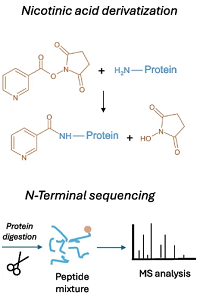
Chemical derivatisation of the N-terminal amino group, and often the amino groups of lysine side chains, is an essential step in most MS-based N-terminal sequencing workflows.
Dimethylation in a mixture of formaldehyde and sodium cyanoborohydride as reducing agent is commonly used for this.
However, various undesirable side reactions have been reported, and both formaldehyde and sodium cyanoborohydride are hazardous chemicals.
The authors of this recent study investigated alternative reagents for protein N-terminal modification.
They compared several chemical labelling strategies, including conventional reductive demethylation with sodium cyanoborohydride replaced with pyridine borane, RapiFluor, 2-pyridinecarboxaldehyde, TMT reagents and nicotinic acid NHS ester.
Each method was assessed for labelling efficiency, selectivity, mass-spectrometric sensitivity and unwanted side reactions.
Following DDA LC-MS/MS analysis, the researchers processed the raw data using Proteome Discoverer 2.1 and searched with Mascot Server 3.0 against the UniProt protein databases for bovine, horse or E. coli proteins, depending on the sample.
Results were then refined using Percolator and a 1% false discovery rate applied, allowing the different derivatisation methods to be compared.
Among the methods tested, nicotinic acid N-hydroxysuccinimide ester was found to be particularly effective, giving sufficiently high labelling yields and strong MS/MS spectra, which allowed the identification of N-terminal peptides from a range of test proteins.
|
|
|
|
|
|
|
|
|
Replacement product keys for new hardware
|
|
|
The price of RAM modules and NVMe storage has soared this year, making the purchase of a new computer a difficult process.
However, sometimes your old PC is near end of life or just dies.
How do you move all the software and data to a new system?
We provide full instructions on what to back up and what to restore for Mascot Server, Mascot Distiller and Mascot Daemon.
As the first step, simply contact us for a temporary product key for the new hardware.
If you have an active support contract, you can move the licence freely to any Windows or Linux system.
If your support has lapsed, you can move the licence freely to new hardware running the same operating system (Windows to Windows, or Linux to Linux).
We're also happy to advise on optimal PC specifications and operating system compatibility.
|

|
|
|
|
|
|
|
|
About Matrix Science
Matrix Science is a provider of bioinformatics tools to proteomics researchers and scientists, enabling the rapid, confident identification and quantitation of proteins. Mascot continues to be cited by over 2000 publications every year. Our software products fully support data from mass spectrometry instruments made by Agilent, Bruker, SCIEX, Shimadzu, Thermo Scientific, and Waters.
Get a quote
|

|
|
You can also contact us or one of our marketing partners for more information on how you can power your proteomics with Mascot.
|




|
|
|
|
|