|
To view this email as a web page, click here. |
|
|
|
Welcome
Proteomics may not be at the top of the list when thinking about cybersecurity. However, from September 2026, the EU Cyber Resilience Act requires software vendors like Matrix Science to actively report exploited vulnerabilities.
This month's highlighted publication assesses the developability of single-domain antibody-chelator conjugates.
Mascot Server includes a role-based access system called Mascot Security, which provides password protection.
|
|
|
|
|
|
 |
|
Mascot: The trusted reference standard for protein identification by mass spectrometry for 25 years
|
Get a quote
|
|
|
|
|
|
EU Cyber Resilience Act
|
|
|
The Cyber Resilience Act (CRA) is a European Union regulation that aims to improve the cybersecurity of all digital products sold in the EU – including proteomics tools.
The regulation applies to companies and manufacturers, not end users, and it applies to any company worldwide whose products are sold in the EU.
There are two key dates: the first phase (reporting obligations) began on 11 September 2026, and the second phase applies from 11 December 2027.
As a user of Mascot products, you don't need to take any immediate action.
The initial phase establishes an EU-wide reporting mechanism for actively exploited vulnerabilities in software products.
This means "a vulnerability for which there is reliable evidence that a malicious actor has exploited it in a system without permission of the system owner".
From September 2026, we now have a formal vulnerability reporting procedure.
If you discover or learn about an actively exploited vulnerability in Mascot Server, Mascot Distiller or Mascot Daemon, please report it to us immediately.
We will triage the severity and if there is concrete evidence of an unlawful or malicious actor, we will report the incident to the EU authorities and contact the affected users with mitigation instructions.
From December 2027, any product release of Mascot Server, Daemon or Distiller will be shipped with a cybersecurity risk assessment, EU declaration of conformity, software bill of materials (SBOM) and relevant technical drawings and documentation required by the regulation.
We are taking this as an opportunity to make a better product for you.
The full story, including easy steps to secure your Mascot products, is in our blog.
|

|
|
|
|
|
|
|
|
Featured publication using Mascot
Here we highlight a recent interesting and important publication that employs Mascot for protein identification, quantitation, or characterization. If you would like one of your papers highlighted here, please send us a PDF or a URL.
|
|
|
Developability Evaluation of Single-Domain Antibody-Chelator Conjugates for Diagnostic Radiotracers
Philipp D. Kaiser, Simon Straß, Sandra Maier, Evgenia Herbold, Bjoern Traenkle, Anne Zeck
Antibodies 2026, 15(2), 22, doi:10.3390/antib15020022
Developability assessment frameworks mitigate risks in antibody drug development.
The authors point out that existing methods are not readily transferable to single-domain antibodies (sdAbs) due to their smaller size, a distinct surface charge distribution and lack of an Fc region.
They establish a strategy for evaluating the developability of sdAbs and their conjugates.
The case study includes two clinical candidates intended as precursors for the production of diagnostic tracers for clinical imaging.
The authors probe the framework integrity and the stability of complementarity-determining regions (CDRs) with intact mass LC-MS analysis and relative quantification by tryptic peptide mapping;
structural integrity with nano differential scanning fluorimetry (NanoSDF);
antigen-binding capacity with size-exclusion chromatography—ultraviolet light detection (SEC-UV);
and chelatability with an LC-MS/MS chelation assay.
For the peptide mapping, stressed and reference samples were subjected to tryptic digestion, then analysed with LC-MS/MS (Thermo Orbitrap Eclipse in DDA mode).
The authors used an in-house protein database containing sdAbs, and peptides were identified with Mascot Server 3.0.
To identify very short peptides, they set minimum peptide length to 4 residues and used a Mascot error tolerant search, which includes semi-specific sequences and unexpected modifications.
Modifications were additionally quantified with Thermo BioPharmaFinder.
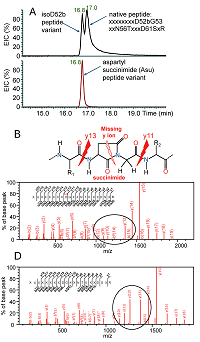
For example, one sdAb candidate displayed a pronounced CDR-localized instability, where fragment-ion spectra confirmed succinimide formation.
|
|
|
|
|
|
|
|
|
Password protection with Mascot Security
|
|
|
Mascot Server includes a role-based access system called Mascot Security.
When enabled, you can restrict access to database searching or the configuration editor by user or group.
The default authentication mechanism is a basic password login, which is not super secure.
We recommend using HTTP authentication provided by the web server (Microsoft IIS or Apache), which can be integrated with the Mascot Security user database.
Mascot Security: password protected administration shows how to restrict access to your configuration files.
Single sign-on (SSO) and Mascot shows how the web server's SSO integration can be used.
And Mascot Security: privacy settings shows how to make database searches private to a user or group.
|

|
|
|
|
|
|
|
|
About Matrix Science
Matrix Science is a provider of bioinformatics tools to proteomics researchers and scientists, enabling the rapid, confident identification and quantitation of proteins. Mascot continues to be cited by over 2000 publications every year. Our software products fully support data from mass spectrometry instruments made by Agilent, Bruker, SCIEX, Shimadzu, Thermo Scientific, and Waters.
Get a quote
|

|
|
You can also contact us or one of our marketing partners for more information on how you can power your proteomics with Mascot.
|




|
|
|
|
|