|
To view this email as a web page, click here. |
|
|
|
Welcome
We are in the final rounds of testing Mascot DIA, a spectrum-centric solution for DIA analysis.
This month's highlighted publication reports on a new method for subtyping amyloid plaques using iprm-PASEF and MALDI imaging.
The Mascot software suite is unique in that it now integrates DIA, DDA and PMF into a single package.
|
|
|
|
|
|
 |
|
Mascot: The trusted reference standard for protein identification by mass spectrometry for 25 years
|
Get a quote
|
|
|
|
|
|
Mascot DIA: sequence-based, spectrum-centric
|
|
|
Mascot DIA is nearing its release date after quite a long development time.
But there are already many DIA software packages.
Why is another one needed?
Most DIA software packages are library-based, while Mascot DIA is sequence-based.
The main advantage is, it will work with any sequence database, enzyme and variable modifications.
Mascot DIA is also spectrum-centric: it finds the peptides that best explain the observed peaks in a given MS/MS spectrum.
As the purpose of mass spectrometry is to identify an analyte from its mass spectrum, this seems like the natural approach.
Unlike other spectrum-centric DIA tools, Mascot DIA uses accurate precursor mass as a filter.
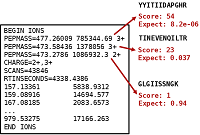
Because some peptides have no MS1 signal, Mascot Distiller 3.0 will include a novel detection algorithm for DIA that infers precursor mass and charge from the MS/MS scan.
The algorithm is data driven, no libraries or prior information are needed, it works with unmodified and modified peptides, and it works with any complementary ion series.
Due to probabilistic scoring, Mascot will never report a peptide match with poor sequence coverage.
Combining this with precursor mass filtering is a strong guard against false positives.
Read more in our blog.
|
|
|
|
|
|
|
|
|
Featured publication using Mascot
Here we highlight a recent interesting and important publication that employs Mascot for protein identification, quantitation, or characterization. If you would like one of your papers highlighted here, please send us a PDF or a URL.
|
|
|
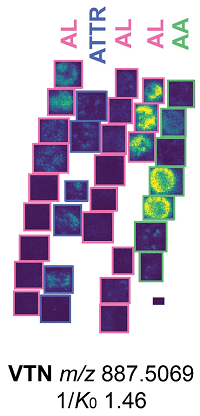
In situ, antibody-independent, and multiplexed characterization of amyloid plaques by MALDI MS/MS imaging using iprm-PASEF
Larissa Chiara Meyer, Mujia Jenny Li, Nadine Meier, Beate Vollmer-Kary, Tobias Feilen, Julie Audebert, Konrad Kurowski, Stephan Singer, Peter Bronsert, Melanie Christine Föll, Oliver Schilling
Analytical and Bioanalytical Chemistry, 418:6633-6646, 2026
Amyloidosis is a group of protein aggregation-based diseases with several subtypes, which are difficult to diagnose due to heterogenous symptoms.
Amyloid plaques in tissue samples are typically detected by staining with Congo red, followed by immunohistochemistry or dissection-based LC-MS/MS, both of which have drawbacks.
The authors develop a new diagnosis method using iprm-PASEF and MALDI imaging, which is rapid, spatial and independent of antibodies.
34 Congo red-positive biopsies were collected from different tissue types from a total of 18 patients, which were applied on a tissue microarray.
The amyloidosis subtype was retrieved from clinical records and included transthyretin (ATTR), immunoglobulin light chain (AL) and secondary AA amyloidosis.
The authors curated a panel of target peptide m/z values, based on exploratory MALDI TIMS MS1 imaging and a literature search.
Using Bruker timsTOF fleX, the precursor list was subjected to iprm-PASEF measurement and resulted in 13,667 pixels, which were split by precursor-specific ion mobility traces.
The mean MS2 spectra were searched with Mascot Server, yielding identifications for ten target peptides derived from seven proteins, including subtype-specific proteins.
The identifications were corroborated by measuring the residual matrix with LC-ESI-TIMS-MS/MS, and the MS1 imaging and iprm-PASEF data were also aligned with clinical annotations.
|
|
|
|
|
|
|
|
|
Mascot DIA, DDA, PMF
|
|
|
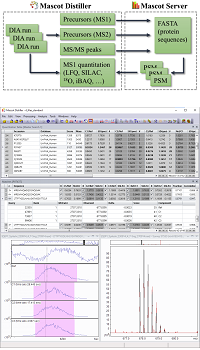
The Mascot software suite includes three products: Mascot Distiller (preprocessing and quantitation), Mascot Server (high-throughput identification) and Mascot Daemon (automation).
With the upcoming DIA support, the Mascot suite now provides a solution to DIA, DDA and PMF data analysis in a single package.
Mascot DIA is a spectrum-centric approach for identifying and quantifying proteins from Data Independent Acquisition (DIA) runs.
It requires Mascot Distiller 3.0 (available soon) and initially supports Thermo Orbitrap, SCIEX and Waters (MSe) instruments.
Mascot DIA is ideal for untargeted and discovery proteomics, because it has no limits: Use any sequence database, variable modifications, enzyme or MS1 quantitation method (label-free quantitation, SILAC, 18O, metabolic).
Mascot DDA is a spectrum-centric approach for identifying and quantifying proteins from Data Dependent Acquisition (DDA) runs.
Mascot Distiller supports all Agilent, Bruker, SCIEX, Shimadzu, Thermo and Waters instruments commonly used in proteomics, as well as all common MS1 and MS2 quantitation methods.
The same data analysis strategy is used for DIA and DDA, enabling direct comparison between acquisition methods.
Mascot PMF is a high-throughput system for identifying proteins from Peptide Mass Fingerprinting (PMF) data.
Mascot Distiller is recommended, and most instrument control systems also produce a suitable peak list.
Mascot Server is one of the few PMF search engines remaining on the market.
|
|
|
|
|
|
|
|
|
About Matrix Science
Matrix Science is a provider of bioinformatics tools to proteomics researchers and scientists, enabling the rapid, confident identification and quantitation of proteins. Mascot continues to be cited by over 2000 publications every year. Our software products fully support data from mass spectrometry instruments made by Agilent, Bruker, SCIEX, Shimadzu, Thermo Scientific, and Waters.
Get a quote
|

|
|
You can also contact us or one of our marketing partners for more information on how you can power your proteomics with Mascot.
|




|
|
|
|
|