New features in Mascot 1.9
Mixture mode for peptide mass fingerprints
All peptide mass fingerprint searches now test for the possibility that the sample is a mixture of proteins. Mascot will automatically detect and report statistically significant protein mixtures of up to six components.
Semi-specific and mixed enzymes
Semi-specific means that Mascot will search for peptides that result from specific cleavage at one terminus, but where the other terminus may be the result of non-specific cleavage. A search using a semi-specific enzyme is a lot faster than a no-enzyme search, but will still find the majority of non-specific peptides.
There are two categories of mixed enzyme definitions. An independent mixed enzyme is used where multiple sample aliquots have been digested separately, and the digests combined for analysis. This means that the sample could contain (say) tryptic peptides and Asp-N peptides, but no peptides that are tryptic at one end and Asp-N at the other. The second category simulates a single sample aliquot being digested simultaneously or serially by more than one cleavage agent. For example CNBr followed by trypsin.
Integrated database download script
A new script to automate the downloading of sequence databases, including dependent files such as taxonomy and Unigene indexes. The script supports passive FTP and resumed downloads.
Improved Voyager data import filter
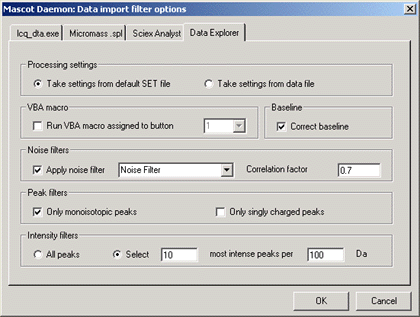
The Mascot Daemon data import filter for Voyager now allows better control over smoothing, de-isotoping and peak selection.
Error tolerant searching
Error tolerant searching of nucleic acid sequences directly implements single base insertions, deletions and substitutions.
Other important changes
- Additional help pages for sequence database setup and tips for specific instrument platforms
- Added z+H ion series for ECD
- HTML pop-ups now work in Opera and Gecko
- Better peptide mass fingerprint scoring for proteins with abnormal AA composition
- Plus some 80 minor tweaks and bug fixes