Distiller precursor detection for DIA
Mascot DIA is a spectrum-centric approach. The search engine makes a list of theoretical precursors (peptides) by digesting the protein sequence database. The list is filtered by observed precursor mass: only peptides within tolerance are selected for in silico fragmentation. Finally, the fragments from each candidate are matched to the spectrum.
Accurate and sensitive precursor detection is crucial for this to work. DIA scan cycles are typically composed of a survey scan (MS1) followed by MS/MS fragmentation of sequential isolation windows, with a full cycle repeating every 3-5 seconds. Precursor masses can most reliably be detected from the survey scan. However, a peptide may have very low intensity or might not be sampled in a survey scan: it may elute fully between survey scans and only get sampled in an MS/MS scan. This means a different algorithm is needed.
Mascot Distiller provides precursor detection for Mascot DIA. It uses a two-stage process.
Stage 1: Look in the survey scans
As with a standard DDA run, precursor detection for DIA starts from the survey (MS1) scan. The survey scan is split into the isolation windows used in the DIA experiment. Precursor masses are selected within each window and assigned to the MS/MS scan corresponding to the same isolation window. The algorithm is the same as precursor detection of DDA data.
Stage 2: Look in the MS/MS scans
In DIA, the assumption is that every scan is chimeric and contains fragments from multiple precursors. If Distiller fails to find more than 1 precursor in the survey scan for any given isolation window, it switches to looking for additional precursor signals in the child MS/MS scan. This algorithm was added in Mascot Distiller 3.0.
There are actually two ways to determine precursor masses from MS/MS scans. You often see unfragmented precursor signal in the MS/MS scans in DIA runs, so one option would be to look in the isolation window region of the MS/MS scan and pick out potential unfragmented precursors from there. In practice, we found this approach isn’t very reliable.
One issue is that if the precursor is missing from the survey scan, it is almost by definition a low intensity precursor, which means you’re less likely to find any unfragmented precursor signal in the MS/MS scan. If it is there, it will be swamped by other noise.
Another issue is that if the ‘raw’ data are actually saved as centroids, as is often the case for data from Thermo Orbitrap instruments, Mascot Distiller won’t detect the charge states of fragment ions without uncentroiding the spectrum to convert it back into profile data. This will significantly extend the processing time.
Instead, Mascot Distiller uses a novel algorithm to infer precursor masses within the isolation window based on pairs of uninterpreted, complementary ions (e.g. b- and y-ions):
- Add together the masses of pairs of fragment ions from the MS/MS spectrum. This gives you a potential precursor MH+ mass plus an additional proton. Take away the mass of the additional proton.
- Compare the candidate MH+ mass:
- Does it fall into the isolation window? If it does, add it to a list of possible precursors.
- If the mass is greater than the isolation window, convert it to a range of default charge states specified in the processing settings (e.g. 2+, 3+). If any of those fall into the isolation window, add the precursor to the list.
- Repeat steps 1-2 until the MS/MS spectrum is covered.
- Now rank the precursors in the long list by the number of times the precursor was observed by different fragment ion pairs and by coverage of the spectrum. Take the top N precursors and assign to the spectrum (N is 10 by default).
The principle is similar to a de novo algorithm proposed by Dancik et al. [1].
Benefits
This approach has several benefits:
- It is data driven from the MS/MS spectrum – you don’t need a library of precursor masses and associated retention times.
- It doesn’t matter what variable (or static) modifications are present on the peptide, and it doesn’t matter what enzyme was used in the digestion step (if one was used at all).
- It determines precursor mass and charge even from centroided data.
- It is largely independent of fragmentation efficiency. So long as the peptide has fragmented well enough to give a few complementary ions, it can determine the precursor mass.
- It works with any complementary ion series: a/x, b/y, c/z, etc.
There is, naturally, a limitation. Consider a peptide that only produces y ions at every collision energy. If the precursor mass cannot be detected from the MS1 scan, then the above algorithm will not detect it from the MS/MS scan either.
Example of MS/MS based precursor detection
Distiller starts from an unannotated spectrum. To make the exposition easier, this example starts from the peptide-spectrum match.
The below image shows the fragmentation of RPQYSNPPVQGEVMEGADNQGAGEQGR in a DIA MS/MS scan, where the precursor m/z and charge state were determined from the MS/MS scan itself.
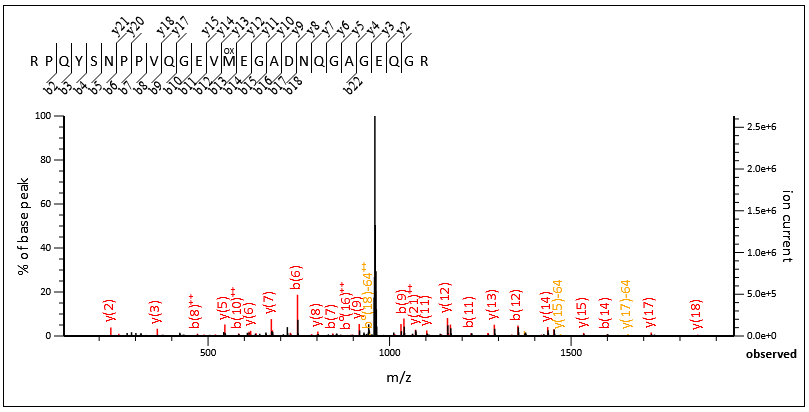
As you can see, we have good coverage across the entire peptide. If we zoom into a region around 1150-1750, we have a number of complementary pairs of ions here, like b12+y15, b13+y14, b14+y13:
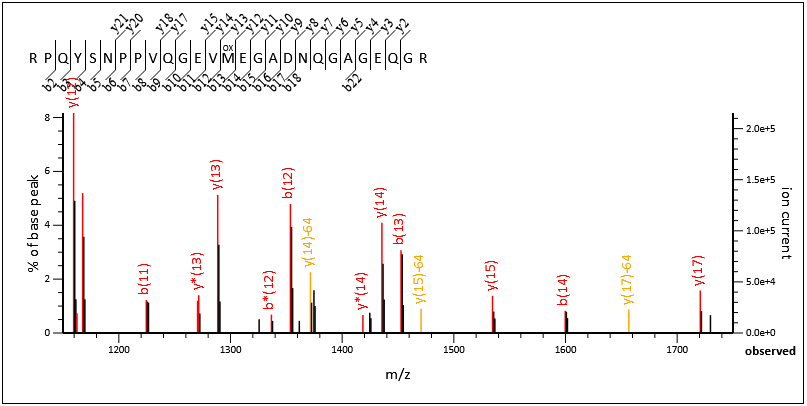
The calculated mass and charge of the first three ion pairs are shown below:
| Pair | m/z b-ion | m/z y-ion | MH+ plus proton |
1+ | 2+ | 3+ |
|---|---|---|---|---|---|---|
| b12+y15 | 1353.652 | 1534.6479 | 2888.300 | 2887.293 | 1444.150 | 963.1024 |
| b13+y14 | 1452.7212 | 1435.5948 | 2888.316 | 2887.309 | 1444.158 | 963.1078 |
| b14+y13 | 1599.7555 | 1288.5535 | 2888.309 | 2887.302 | 1444.155 | 963.1054 |
The isolation window for this MS/MS scan was 956.687-964.687, so the 3+ candidates fit into the window. Distiller takes an average across the ion pairs, which yields the candidate 963.10696,3+ The figure below shows the counts of b/y complementary pairs for the different precursor masses in the isolation window identified from the MS/MS scan. In this case, our precursor m/z 963.10696,3+ is a clear outlier:
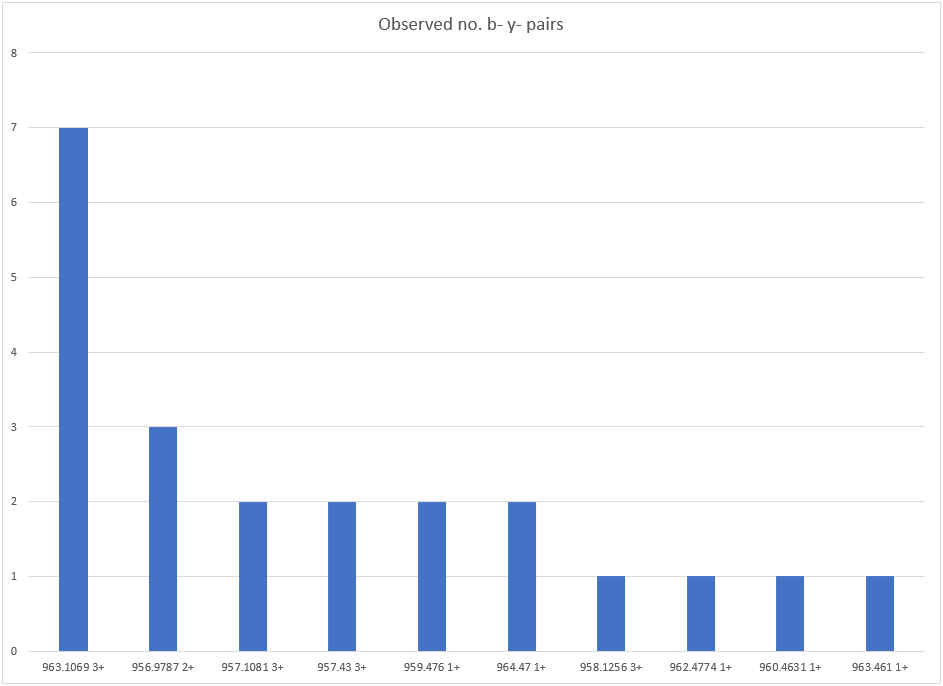
Distiller determines the percursor mass and charge as 963.10696,3+ and, after the database search, the precursor error is found to be 1.37ppm. Note that although there are strong unfragmented precursor peaks in the isolation window region of the MS/MS scan, none of those match this precursor.
Reference
- Dancik V, Addona TA, Clauser KR, Vath JE, Pevzner PA. De Novo Peptide Sequencing via Tandem Mass Spectrometry. Journal of Computational Biology 6(3/4):327-342. DOI: 10.1089/106652799318300