Mascot for Data Dependent Acquisition (DDA)
Mascot DDA is a spectrum-centric approach for identifying and quantifying proteins from Data Dependent Acquisition (DDA) runs. It is built on three products: Mascot Distiller (preprocessing and quantitation), Mascot Server (high-throughput identification) and Mascot Daemon (automation).
In DDA, the mass spectrometer runs a survey scan (MS1) and selects the top-N precursors for fragmentation (MS2). The cycle repeats at regular intervals until the end of the LC gradient. Each MS2 spectrum typically contains fragments from one precursor, which are selected in a data dependent manner. The identification of peptides from DDA spectra is relatively simple. On the other hand, the instrument is usually programmed to select precursor ions in intensity order, which may introduce sampling bias against low-intensity precursors. An alternative to DDA is Data Independent Acquisition.
Mascot supports both DDA and DIA.
Why should I use Mascot for DDA?
Mascot DDA is ideal for untargeted and discovery proteomics, because it has no limits.
- Use any sequence database, from a single proteome to the entire UniProt database (hundreds of millions of sequences).
- Use any variable modifications from Unimod (~1500 mods) or add your own.
- Use any enzyme or search for semi-tryptic or endogenous proteins.
- Use any quantitation method based on MS1 signal – label-free quantitation, SILAC, 18O, metabolic.
- Use any quantitation method based on MS2/MS3 reporter ions – TMT, TMTpro, iTRAQ.
- High-throughput client-server architecture – any number of client programs can use the same protein identification server.
Mascot is ideal for DDA because of its reliability.
- Universal probabilistic scoring – works with any instrument and acquisition strategy.
- Universal peak detection – works with any instrument and is independent of machine learning.
- Peptide identifications are inherently reliable – Mascot will not report a match unless it has statistically unambiguous fragmentation evidence.
- Protein identifications are inherently reliable – every protein hit must have unique peptide evidence.
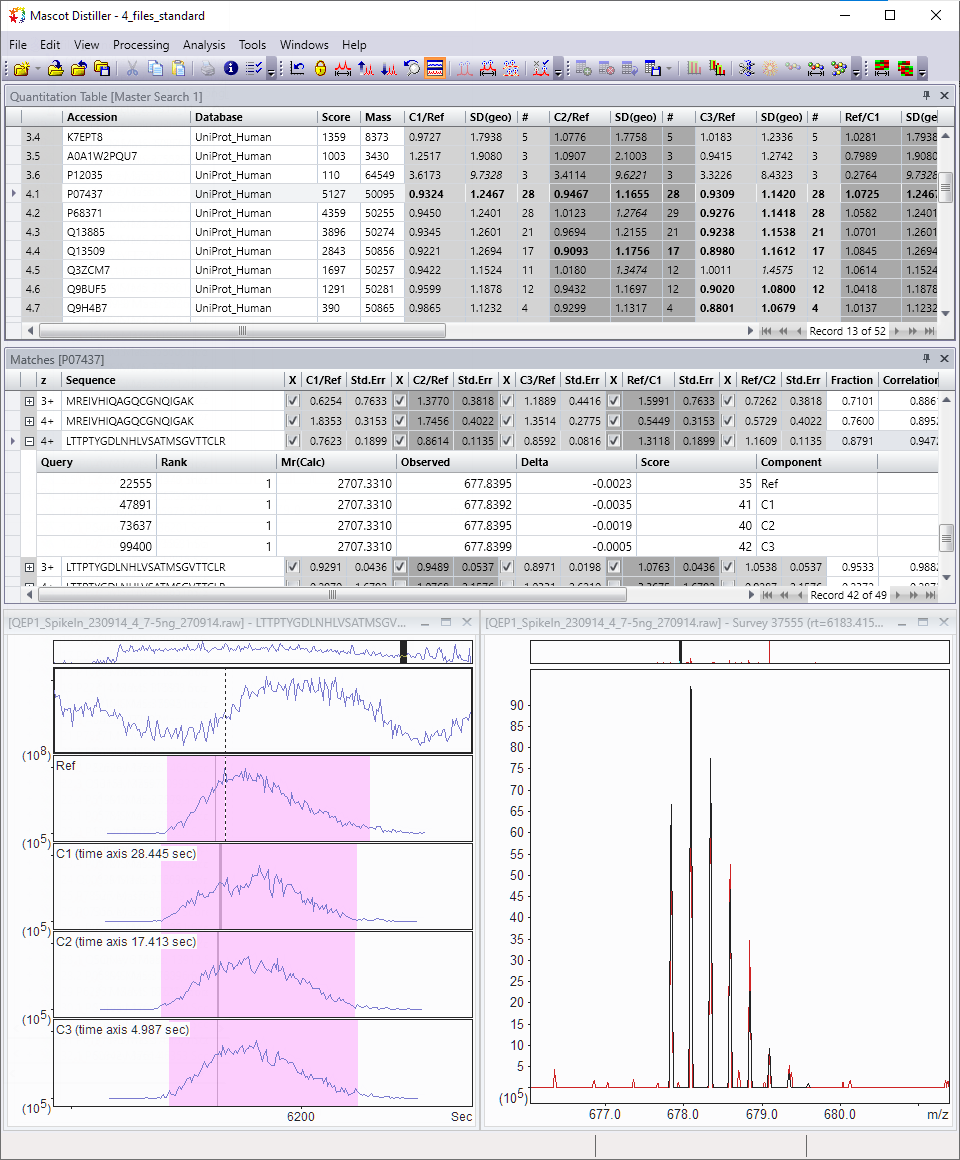
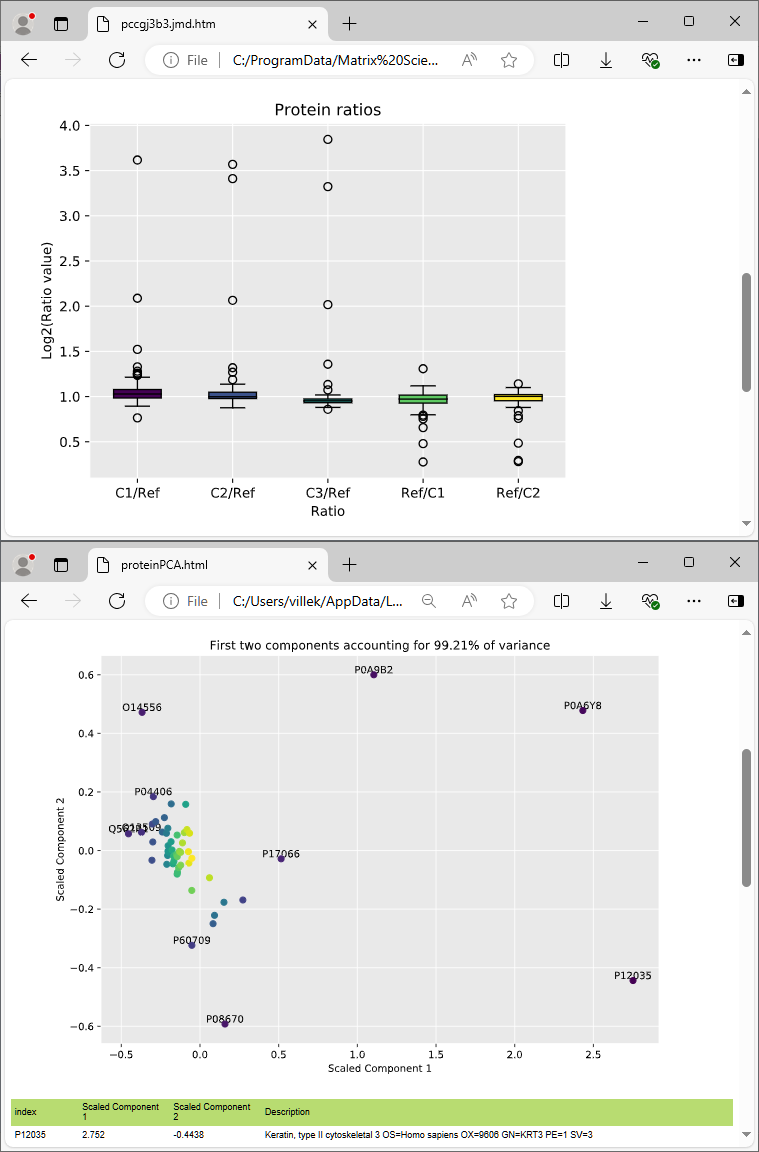
Don’t just take our word for it. Drill down in the interactive reports to inspect the MS/MS spectral evidence, XICs and time alignment results. A number of quantitation and quality reports are included out of the box.
What do I need to get started?
DDA support is built in to all versions of Mascot Server. You are welcome to use the free service at matrixscience.com for trial purposes.
You will need to convert your raw data into peak lists in Mascot Generic Format (MGF) or mzML format. Many software packages and free tools are available:
- Mascot Distiller is a vendor independent application for processing raw data and quantifying proteins.
- Alternatively, use an instrument data system (for example, Thermo Proteome Discoverer™, Bruker BioTools, Waters UNIFI).
- Alternatively, use a free tool like ProteoWizard msConvert.
If you need a new licence or wish to evaluate Mascot Server on your own hardware, please contact us or get a quote.
Which instruments are supported?
Mascot DDA is available for all Agilent, Bruker, SCIEX, Shimadzu, Thermo and Waters instruments commonly used in proteomics.
Mascot Distiller has been designed to work with raw data from any instrument. The data file could contain a single, low resolution MS scan or it could be a complex, high resolution, DDA run from a hybrid instrument. All Distiller parameters can be optimised to a specific workflow.
Mascot also supports DIA analysis.
What is the Mascot DDA LFQ workflow?
The Mascot DDA LFQ workflow is exactly the same as the Mascot DIA LFQ workflow:
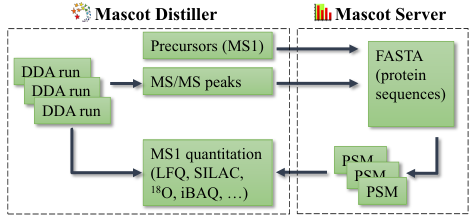
Mascot Distiller reads vendor raw files, processes the MS/MS spectra into peak lists and determines potential precursor masses for each MS/MS spectrum. Precursors are detected from MS1 survey scans. Distiller submits the peak lists to Mascot Server for identification by database searching.
Mascot Server tries to match peptides from a protein sequence database against the observed MS/MS spectrum. Candidate sequences within precursor tolerance are matched independently to the spectrum, allowing multiple precursors to match simultaneously. Mascot calculates a probabilistic match score for each match. At the end of the search, matches are rescored in multiple dimensions using Percolator, and optionally predicted fragment intensities (MS2PIP) and retention time (DeepLC).
Mascot Distiller imports the identified peptides and proteins, and calculates the extracted ion chromatogram (XIC) for each peptide from MS1 signal. Multiple runs are aligned in the time dimension based on shared peptide matches. Peptides not identified in the database search may be identified using precursor mass and accurate retention time (“match between runs”). Finally, protein quantitation ratios are calculated from the XICs.
Mascot Daemon automates all steps of preprocessing, database searching and quantitation.
Does Mascot DDA support MS1 or MS2 quantitation?
Mascot Distiller implements a range of MS1 and MS2 quantitation methods. For MS1 quantitation, this includes label-free methods (LFQ) and any chemistry that creates a precursor mass shift (18O, metabolic, SILAC, etc.). For MS2 quantitation, we recommend using reporter ions (TMT, TMTpro and iTRAQ).
What is spectrum-centric analysis?
Spectrum-centric analysis is the traditional strategy for DDA data.
The goal of spectrum-centric identification is to explain as many peaks in the MS/MS spectrum as possible. The peptide that best explains the peaks is reported as the best identification if a statistically significant number of theoretical fragment masses match to the observed peaks.
Advantages of spectrum-centric searching:
- Peptide identification requires a strong run of fragment ions, which increases identification reliability and confidence.
- There are no limits on sequence database size, number of variable modifications or enzyme.
- Works with any instrument and any ion series (a, b, c, x, y, z, z+1).
- Uses all the information in the spectrum, including neutral losses, for PTM localisation.
Disadvantages:
- If a precursor has no MS1 signal, then the instrument will not try to fragment it and it cannot be identified.
- If a precursor is very weak, the instrument might not choose it for fragmentation and it cannot be identified.
- If a precursor produces only a few fragments, it cannot be confidently identified.
Data Independent Acquisition (DIA) is an alternative to DDA.
What kind of PC hardware does Mascot DDA require?
If you are analysing data from one instrument, we recommend a Small Mascot Server licence and an AMD Ryzen 7/9 or Threadripper processor with 8-16 cores, or equivalent Intel Gold or Core i9 processor. Choose a processor with high clock speed (>4GHz) as performance per core determines the database search duration and peak picking performance. You should have 32GB RAM and at least 2TB of fast disk space (NVMe).
If you are analysing data from multiple instruments or require more throughput, we recommend a Medium or Large licence and a processor with 16-32 cores.
You can run Mascot Server and Mascot Distiller on the same PC or different PCs. Mascot Server and Mascot Distiller run on the CPU and do not require a GPU.
For more details, see PC specification for Mascot Server and PC specification for Mascot Distiller.