Mascot DIA: sequence-based, spectrum-centric
Mascot DIA is nearing its release date after quite a long development time. It is a spectrum-centric solution for analysing DIA data, built on three products: Mascot Distiller (preprocessing and quantitation), Mascot Server (high-throughput identification) and Mascot Daemon (automation). Why is there a need for yet another DIA software tool? What makes Mascot DIA different?
Sequence-based, spectrum-centric strategy
In data-independent acquisition, the mass spectrometer runs a survey scan (MS1), followed by sequentially isolating and fragmenting several m/z ranges (MS2). The cycle repeats at regular intervals until the end of the LC gradient. Each MS2 spectrum is a convolution of fragments from several precursors with similar m/z and retention time.
Dozens of DIA data analysis strategies and tools have been published in the last decade. Ronghui Lou and Wenqing Shui provide a useful classification in Acquisition and Analysis of DIA-Based Proteomic Data: A Comprehensive Survey in 2023. Figure 4 in the paper counts no fewer than 23 open access tools, not including commercial ones, implementing five distinct data analysis strategies.
In terms of Lou and Shui, Mascot DIA is a sequence-based strategy. Very few software packages are in this category; the majority of DIA tools are library-based. Sequence-based search means digesting a protein sequence database into peptides, then somehow matching those to the observed data. The main advantage over library-based search is, it will work with any sequence database, enzyme and variable modifications.
Mascot DIA could also be called a spectrum-first approach, although Lou and Shui reserve the term for library-based searching. We prefer the term spectrum-centric. Spectrum-centric strategy means analysing MS/MS spectra independently and reporting the peptides that best explain the observed peaks in a given spectrum. As the purpose of mass spectrometry is to identify an analyte from its mass spectrum, this seems like the natural approach.
How Mascot DIA works
The input to a Mascot database search is a query, which contains the MS/MS spectrum, retention time (RT), scan number and one or more precursor masses (m/z and charge). Precursor masses must be specified upfront; it is not sufficient to specify an open mass range. Mascot prepares the MS/MS spectrum by dividing it into 55Da windows, and within each window, selects peaks in intensity order. The purpose is to select peaks that are clearly not noise compared to peaks around them.
For each precursor mass, Mascot selects peptides from the protein sequence database that are within tolerance of the observed mass. (Retention time filtering is not used; see further below on RT refinement.) The candidate peptide is fragmented in silico and the theoretical fragment masses matched to the selected peaks. The null hypothesis is, peak matches are independent and identically distributed occurring at a constant rate. Any deviation, such as a strong run of y ions, results in small probability under the null hypothesis, which leads to a high score.
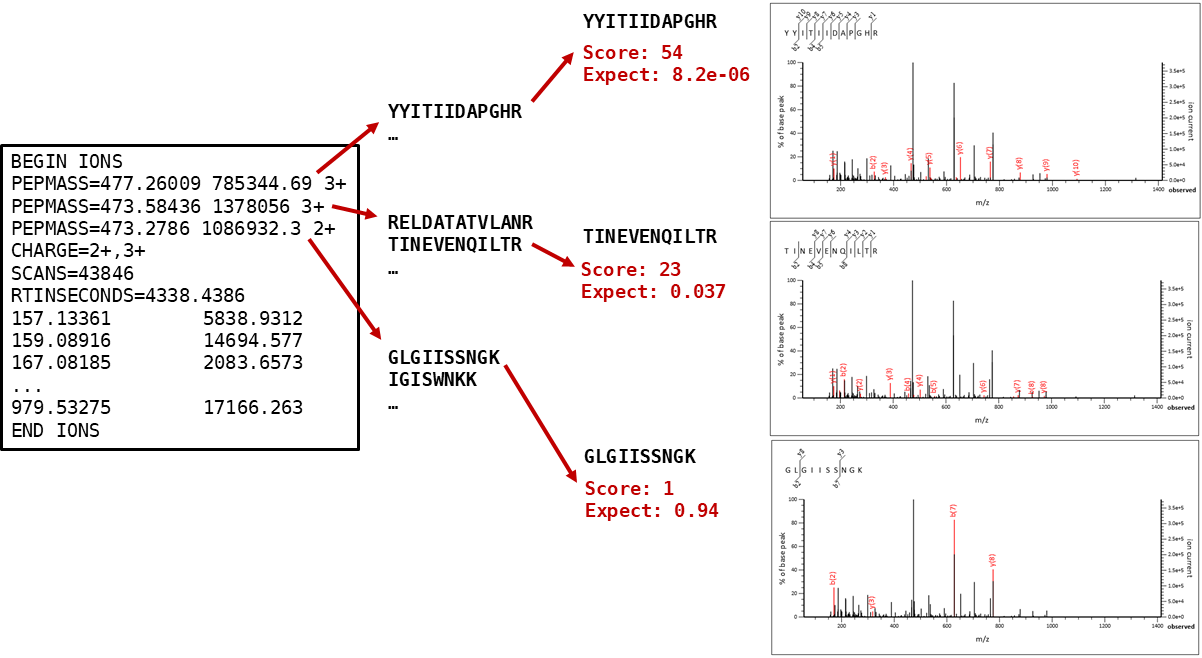
Precursors are matched and scored independently. If a query specifies 3 precursor masses, it will have a maximum of 3 peptide matches. Two peptides with identical precursor mass but slightly different sequence (e.g. two swapped amino acids) compete and the one with the best peak evidence wins. Occam’s razor is most often the right approach. If these peptides are truly coeluting and coisolated, and if they have the same number of matched fragments, then Mascot reports it as an ambiguous match with identical score. Retention time refining may resolve the ambiguity (see below).
How do MSFragger-DIA, CHIMERYS and DIAmeter work?
To show why Mascot DIA is different, it is useful to have some knowledge of how other search engines work. Mascot DIA, and the three tools below, match chimeric spectra directly (or “undeconvoluted” spectra as per Lou and Shui) and they are all sequence-based, spectrum-centric approaches.
MSFragger-DIA runs an open search where a precursor mass range is calculated from the isolation window and a range of charge states: any peptide whose mass is within range is selected. This may result in spurious matches that share many fragment peaks, which MSFragger-DIA has to remove with a subtractive approach. Given a list of candidate peptides for a spectrum, it selects the highest-scoring match, removes its peaks from the spectrum and re-scores the remaining peptides until no peaks remain. Other criteria are also implemented, such as a concordant elution profile between precursor and fragment ions.
CHIMERYS selects theoretical peptides from a database whose mass is within the isolation window and predicted retention time similar to the observed retention time. A predicted MS/MS spectrum is generated for each candidate. Then, CHIMERYS finds the best linear combination of pure spectra whose sum most closely matches the observed spectrum. Matches are subject to other requirements too, such as minimum number of matching peaks.
DIAmeter, which is part of the Crux toolkit, runs a DDA database search where the only constraint is for the peptide mass to be within the isolation window, keeping up to 1000 peptide matches per spectrum. Incorrect matches are filtered out based on Percolator rescoring and using metrics such as the elution profile between precursor and fragment ions.
For a description of library-based strategies, which are quite different from these, please refer to the Lou and Shui (2024) review.
Precursor mass
Having to specify observed precursor mass upfront is unusual compared to these other tools. The principle is simple: If a peptide produces no detectable signal, meaning it has neither MS1 evidence nor detectable fragments, it’s pointless to try to identify it with a database search. You waste compute time and you increase the risk of false positives by “detecting” a peptide from noise.
In DIA, high and medium intensity peptides almost always have MS1 signal. Precursor detection from MS1 scans is a solved problem, as it’s the bread and butter of DDA analysis. Mascot Distiller fits an ideal isotopic distribution to the experimental data, which is adjusted by varying the mass, resolution, intensity, and charge state, so as to maximise the correlation with the experimental data. The algorithm deisotopes the signal as well as determines the charge state.
However, low-intensity peptides or those not sampled in a survey scan require a different treatment. Mascot Distiller 3.0 will include a novel detection algorithm for DIA that infers precursor mass and charge from the MS/MS scan.
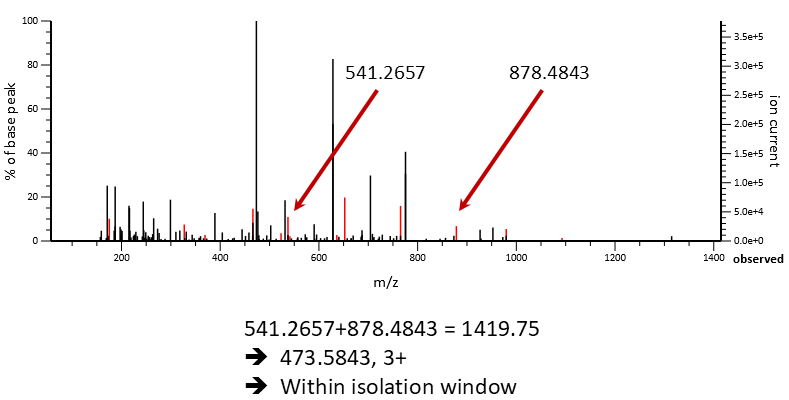
Precursor detection from MS/MS is illustrated in the diagram above. The algorithm is data driven, no libraries or prior information are needed, it works with unmodified and modified peptides, and it works with any complementary ion series. The algorithm automatically omits precursors whose fragments are not detectable.
Noise-resistant scoring
Intensity-based peak selection is crucially important to preventing false positives. Without it, you can match anything to anything, even with high mass accuracy and tight mass tolerance. However, the observed intensity provides sufficient discrimination; predicted peak intensities are not necessary during the database search.
Mascot Server 3.2 will include noise-resistant scoring for DIA, which is a probabilistic scoring model. Noise-resistant scoring is able to ignore extra peaks from unrelated precursors as well as unfragmented precursor signal. As more peaks are selected, the number of fragment matches may keep increasing, but at some stage, the score will start to decrease. This is because the number of peaks selected matters as much as the number of fragment matches.
When matching a low-intensity peptide, the peaks from the higher-intensity peptides are included in the peak count as unexplained peaks. The more peptides in the spectrum, the harder the identification problem becomes. The optimal isolation window is ‘narrow’ width, between 2 m/z and 8 m/z, so that the MS/MS spectrum contains fragments from at most 5 peptides. This is a general limitation of spectrum-centric searching as also noted by Frejno et al. (2025), who found that identification rates for CHIMERYS also start to plateau or drop after 8 m/z.
Due to probabilistic scoring, Mascot will never report a peptide match with poor sequence coverage. It’s not sufficient to match one or two y ions and one or two b ions, because thousands of peptides that are unrelated to the spectrum may produce spurious matches like this. Precursor mass filtering with probabilistic scoring is a strong guard against false positives.
Retention time refining
Unlike most DIA tools, the Mascot database search does not use retention time as a filter. At first, it may seem odd: why waste compute time on peptides that cannot be present at the observed RT of the spectrum?
Well, RT prediction is not infallible, and a prediction model needs to be calibrated to the data (usually with a two-pass search). Peptides sometimes elute in a strage way, such as appearing as two peaks a few minutes apart, or “smearing” over a long time period. You could also swap liquid chromatography for ion mobility separation. It is better to let the MS/MS evidence lead the way and refine the results after the database search.
Mascot Server includes Percolator for rescoring, plus MS2PIP for fragment intensity prediction and DeepLC for RT prediction. The latest version ships with DeepLC 4.5, which comes with a multitask pretrained model covering 6,543 LC setups. It produces excellent results for anything from 5 minute to 3 hour gradients.
Retention time refinement has two steps. The DeepLC model is calibrated on the best-scoring database matches. Then, DeepLC predictions are fed to Percolator for rescoring. The refinement solves two issues: It boosts peptides that occur at the expected RT, and demotes peptides that are far off. For example, if the top-scoring peptide to a precursor is one that has a 15-minute RT error, rescoring will demote it.
Summary
Mascot DIA provides reliable peptide identification from chimeric spectra by using a precursor mass constraint, noise-resistant probabilistic scoring and retention time refinement. For more details, have a look at Mascot for Data Independent Acquisition.
Keywords: chimeric spectra, DeepLC, DIA, Mascot Distiller, MS2PIP, peak picking, scoring